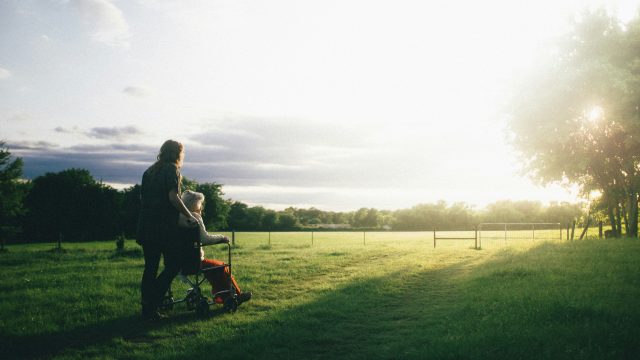
My mum has always had a background in care-giving, and from her caring nature I have adopted many characteristics that have shaped me as an individual in my own life. Even though she is very humble through her ability to care for others I feel that she approaches daily life with the mindset of always putting other’s needs before her own.
However, despite her presentation of strength to those around her, she suffers with her own mental health as she lives with depression, and this for her comes as a consequence of her care-giving. She feels as if she has very little time for herself, she struggles sleeping and has a persistent low-mood. This was further amplified when my Grandad passed away, whilst in her care.
My mum feels that care-giving is a difficult role at times because it is hard to separate her work from her own life. Sometimes if she has to deal with situations that are challenging and quite emotionally demanding, then it may lower her mood following work. I remember growing up that we had to cancel quite a few arrangements at short notice because she was exhausted from her work both emotionally and physically. My mum said to me ‘one of the toughest things I had to deal with was watching someone with Alzheimer’s or Dementia’s mental health slowly decline.’ I know that when I was younger I would get frustrated at why my mum was quite unhappy at home, however now being older I finally understand how care-giving can impact your life outside of the position itself.
The lowest point my mum had was when she transitioned from being a carer within care-homes to being a carer for elderly relatives. This was the lowest point because, when there came a time when they passed away, she struggled a lot more with grief as the personal connection she felt to them often meant that the demand and reliance on her was higher, as she could no longer just simply visit them without having to attend to give care.
When her work in care-homes was emotionally difficult, we could all offer support, however because the loss of my Grandad affected us all we couldn’t offer the same support as we were all struggling through grief. My mum was diagnosed with depression and was prescribed anti-depressants as treatment. There was a couple of months where symptoms of depression became really prominent in my mum’s behaviour when my Grandad passed away.
She was in a consistent low mood and spent the majority of her days at home as she felt as though she lacked purpose. When she cared for people in care homes there were multiple carers who could share the tasks amongst them. However, when she became a family carer it meant that all her time and energy was focused upon one person. She mostly suffered from low moods, not wanting to socialise, and just wanting to shut the world out. Therefore, in losing that person, she felt as though her purpose had been diminished and furthermore, when paired with the emotional personal loss and grief, at times she would tell me it felt like her whole world was ending.
My mum felt reduced to a label, through her diagnosis, as it made her feel misunderstood and dehumanised. From my perception, my mum struggled to come to terms with her diagnosis because she longed to maintain her presentation of a strong, passionate care-giver, despite living with depression.
I remember a few months after my Grandad had passed away, I returned home from a long day at University to find that my mum had not left her room all day, and when I asked, “What she had been doing that day?’’, I was surprised at the outcome. She said she had not done anything and had simply just wanted to shut out the world for a day. I reassured her that it was okay to feel the way she was feeling, however I was concerned as it was out of character for her.
I feel I personally learnt a lot about how to support someone suffering in this period of time, and despite also suffering with grief myself, I learnt ways to utilise hobbies as an outlet. Because of this, I proposed to my mum that she join in on some of the hobbies I had undertaken. These hobbies included: going running or walking to get out into the natural environment, writing and journaling as a way of getting my feelings out, baking for friends and family.
Whilst these may not have been something that my mum would have done before, I felt that it would help her in a similar way to me, and it would help for us to do something together, so that she didn’t feel isolated.
Before writing this story, I spoke to my mum and asked her to reflect on whether she felt like there was a turning point in her experience. After some time of reflection, she said to me that she felt a strong sense of pride if she was able to go for a walk in the morning as this was something that she previously had loved to do.
Though this seems like a simple task, the way my mum was feeling she really struggled to leave the house, so eventually when she was able to do this without giving it a second thought, it really was an accomplishment. By taking a set amount of time each morning to be outside amongst the local green spaces it enabled her to become more social and brought her a sense of calmness, which was a huge contrast to the previous low moods she had been experiencing.
A second turning point that I have personally noticed through being around my mum in the years following my Grandad’s passing is seeing her choose to return to what she loved doing before: care-giving. Her return to caregiving was not by any means an easy option, due to being aware of the heightened sense of grief and emotional trauma of caring for a family member. However, my Grandma suffered from a fall and her health has since declined. This means that she struggles both physically and psychologically, her ability to do simple household tasks and remember specific things has diminished. Seeing the impact that the fall had on my Grandma, my mum wanted to help her, but in doing so she never expected to redevelop her purpose and feel a sense of belonging that she did before. She is now my Grandma’s primary carer.
Despite previously being at a crucially low point in her life, my mum through navigating depression incorporated the tools to be able to ensure that her mental health took priority, even when looking after someone else. This is something that she personally feels she didn’t prioritise before.
My mum still has struggles, although less frequent, depression is not something that goes away. But as my mum says, being diagnosed with depression is nothing to be embarrassed about. Getting a diagnosis should not be stigmatised, when looking back at her journey over the years, even though at first her diagnosis made her feel reduced, she can now appreciate that it brought her to a position where she could acknowledge the small changes she could make to prioritise herself.
In caring for other people, my mum found a part of herself that mattered too.
Thank you for taking the time to read this story.